
Customer Service for Steel Structures

Customer Service for Steel Structures

Successful metal building sales— in fact, successful sales for any product— start with creating a relationship of mutual respect with your buyer by providing excellent customer service.

From initial discussion to the finished building, Tekmetsan promises an excellent customer service throughout the life cycle of its building projects.

Along with our superior building, our excellent customer service brings repetitive sales and allow word of mouth marketing.

Over 70% of our sales are coming from our existing customers or those referred to us by previous customers, reflecting of our excellent customer satisfaction.

We are proud of earning the trust of our customers.  We will honour that trust by our continued commitment to providing the highest money for value and excellent customer service.

Metal Building projects are multi-party projects involving architects, local building officials, project engineers, general contractors, steel erectors, mechanical contractors and etc. High number of different parties generally increases the likeliness of possible problems. Our technical sales team are always one call away if you experience any issues related to our steel structure.

TEKMETSAN never neglects or avoids the customer after the sales. We do our best to make your steel structure experience trouble free.
However, if problems do arise, we do not abandon our customers after the metal building ships. With all our combined years of experience, it is unlikely you can have any problem that we have not encountered— and solved— before.

Conclusion

For the best steel buildings and excellent customer service, you can rely on TEKMETSAN steel buildings.

Solar Panels on Metal Buildings

Solar Panels on Metal Buildings

As the solar panel costs continues to drop, and the technology behind the solar energy devices advances, people are more often preferring to use them on pre-engineered steel buildings

There are various valid reasons why it is a good idea to put solar panels on top of the roof;

• Saving money on your electricity bill or offsetting your energy costs by selling electricity to the grid

• Taking advantage of an underutilized energy resource 

• Helping tackling global warming by reducing the dependence on fossil fuels

• Promote your company as a technology leader

Silicon solar cells are easily broken and have fragile wiring connecting them, so they need solid support such as that provided by an aluminium and glass encasement. On most traditional roof systems, that requires a racking system anchored to the roof by drilling into the roof’s surface.
Any roof penetration is, in the long run, a potential leak; and wind action on the panel can pull on the fasteners, which may widen the roof-holes over time. Mounting to a metal roof is a better option.
Depending on the type of the roofing type of a metal building, solar panels have different connection apparatus. But none of the mounting parts require a hole on the roof panel thus providing a safe and long standing connection between the solar panel and roof panel.

Solar panels are extremely durable and can last for 25 to 30 years, which is part of what makes them such a great investment for your building. 

However, in many cases, this means that your solar panels can outlive your roof, which can result in an added expense. If your roof is aging, you have to replace it before installing solar panels, or incur the additional cost of removing and re-installing your panels when the time comes to replace your roof. 

Metal roofs, on the other hand, are the most durable conventional roofing material available. If you have a metal roof on your building, it will likely last longer than the lifespan of your solar panels, which reduces expense and hassle in the long term.

Conclusion

Our goal at Tekmetsan is to give you the easiest building solutions without compromising quality. We take the additional solar panel loads on the roof into consideration in the steel design process which may sometimes increase the cost of the metal frame slightly.
Contact us to learn more about the features of our metal building systems adaptable for solar panel installation.

Portal Frame Buildings

Portal Frame Buildings

One of the most important decisions in purchasing a pre-engineered steel building is choosing the type of framing.  Which best fits the end-use, size, design, specifications, and budget for your project?

A Tekmetsan steel framed building uses “portal frame” steel framing.

Portal frame buildings are low-rise structures consisting of rafters and columns which are connected to moment-resisting connections for super strength.  As a result, they are constructed bay by bay which make them very fast to erect on site.  They were first developed in the 1960s, and have now become the most common form of construction.  

Portal frame construction is therefore typically seen in warehouses, barns and other places where large, open spaces are required at low cost and a pitched roof is acceptable.

Clear Span Steel Building

The frame of a clear span building is self-supporting and requires no interior columns.  The interior is completely open and unobstructed.

A clear span system provides the maximum amount of usable floor space and maximum floor plan flexibility.

Clear span structures are available up to 30 meters in width on Tekmetsan standard steel structures.
Clear span widths of over 30 meters are also possible with a custom order.
Typically, clear span framing works well wherever manoeuvrability is a factor.
Clear span structures are ideal for:

• Agricultural Buildings
Aircraft and Helicopter Hangars
• Factories and Workshops
• Manufacturing Facilities
• Recreational Facilities and Gymnasiums
• Storage Buildings
Warehouses

As the open-span width increases, the size and weight of the steel framing members must also increase to handle the structural load.

Modular Metal Framing

In modular framing, interior columns evenly distribute the structural load. Therefore, modular steel structures require lighter steel. Less framing weight reduces the cost of not only the steel building framing, but often the foundation as well.
Generally speaking, the wider the building, the greater the savings with a modular frame.
Unless unobstructed floor space is critical to the operation, most steel framed buildings wider than 30 meters use modular span framing. These may include:

• Distribution Centres
• Industrial Facilities
• Manufacturing Plants
• Warehouses

If clear span space is not paramount to your building’s operation, consider getting quotes for both systems for comparison of pricing.

Conclusion

Clear span designs offer the most usable space; modular designs create the most economical steel structures.

Whatever your metal building needs, Tekmetsan’s steel building framing specialists can provide you with expert guidance in choosing the best steel framed building for your specific application.  Our friendly and experienced staff will answer all your questions from building concept to completion

How to Prevent Structural Steel from Rusting

How to Prevent Structural Steel from Rusting

Steel is a robust, resilient and durable material which can main its structural integrity for decades if it is not exposed to corrosion. All steel materials, including steel structures, are susceptible to rust. If steel is not protected, rust is mostly unavoidable therefore all steel fabrications are subject to coating for a long lifetime. This blog will present techniques and methods on how to avoid corrosion on steel structures.

What is rust?

Rust is the term used to describe red iron oxides produced when ferrous metals corrode. Rust is the common name for the chemicals that result when iron reacts with oxygen and water. “Rust” is poorly defined in chemistry, however—lots of chemicals can be formed when iron is left exposed.

What causes rust?

Any material made with iron that is exposed to both oxygen and water will rust. Because steel is made almost entirely of iron, it is the most highly manufactured man made material that is subject to rust. 

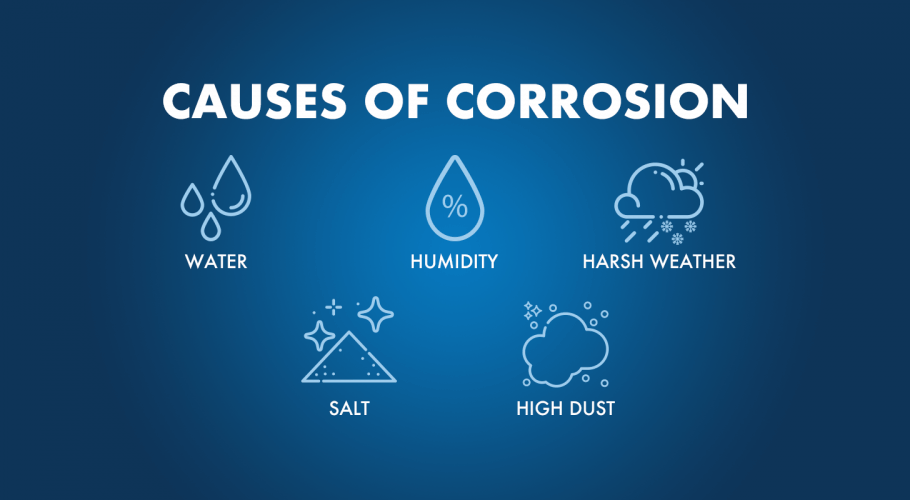
While steel buildings and beams are structurally sound and stable, water molecules can penetrate those microscopic, near-invisible gaps within the steel. Once they creep within the metal, it starts to corrode slowly. Where salt is present – in seawater, for example – the corrosion process will be quicker. The presence of salt acts as a catalyst, accelerating the corrosion chemical reaction process

Types of Coatings

Galvanised steel is an excellent solution for preventing rust. The steel product is coated in a zinc layer, which acts as a protective barrier for the metal underneath, against oxygen and water. Zinc is more reactive than iron, so the zinc oxidises, rather than the metal itself. 

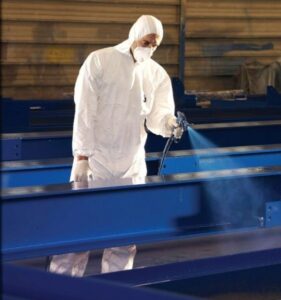
Protective paint systems usually consist of primer, intermediate/build coats and finish coats. Each coating ‘layer’ in any protective system has a specific function, and the different types are applied in a particular sequence of primer followed by intermediate/build coats in the shop, and finally the finish coat (or top coat) either in the shop or on site.

• Powder coating

Powder coating involves adding dry powders to clean surfaces, heating the object and subsequently turning the powder into a thin film. This film adds another layer of protection for structural steel surfaces against corrosion.

The coating type of each steel structure should be decided based on the below criteria;

• What kind of painting conditions are we working with?

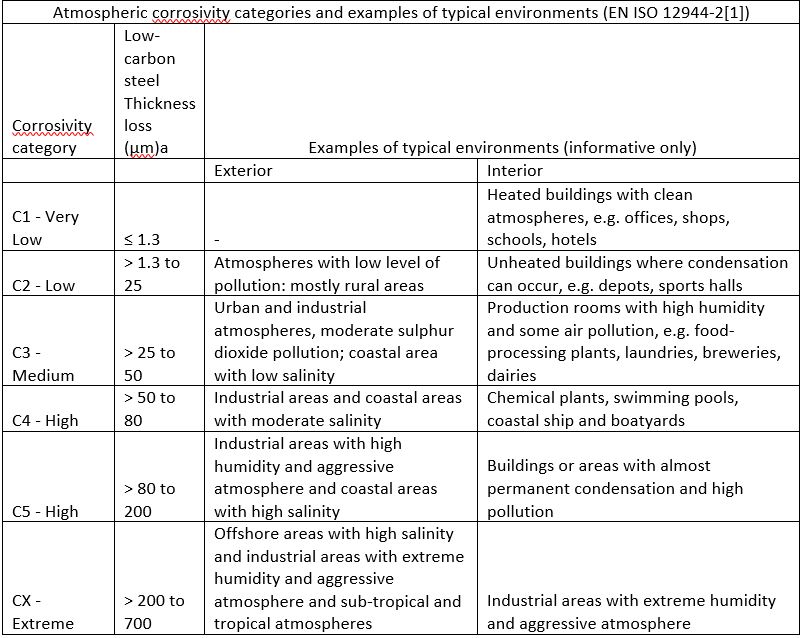
• What kind of environment is our end product used in? (Is it indoors? Or are there harsh weather conditions?)

• What types of metal surfaces are we working with?

• How long do we want the paint to hold?

As with any field or industry, there are certain standards and regulations that need to be taken into account when deciding which product to go with. Tekmetsan complies with ISO 12944 International corrosion protection standard in its products.

 
Conclusion:

Tekmetsan technical sales team will guide you in choosing the best paint system tailored to your needs.

Steel Fabrication Process

Steel Fabrication Process

Fabrication is the process used to manufacture steelwork components that will, when assembled and joined, form a complete frame or structure.

At Tekmetsan, we usually use readily available standard sections that are purchased from the steel mills, together with such items as protective paints and bolts from other specialist suppliers. 

Our modern steelwork fabrication shops have computer-aided design and detailing (CAD), which is linked directly to factory floor computer numerically controlled (CNC) machinery, creating a genuine seamless CAD/CAM environment. The accuracy of the computer-generated details being transmitted directly to the CNC machinery increases the quality standards of our production.

Steel Fabrication Steps

While the architect creates the blueprint, a fabricator evaluates the steps with steelwork and recommend alterations that could be done to the shop drawing. And then, approval or rejection of these recommendations is done by the architect.

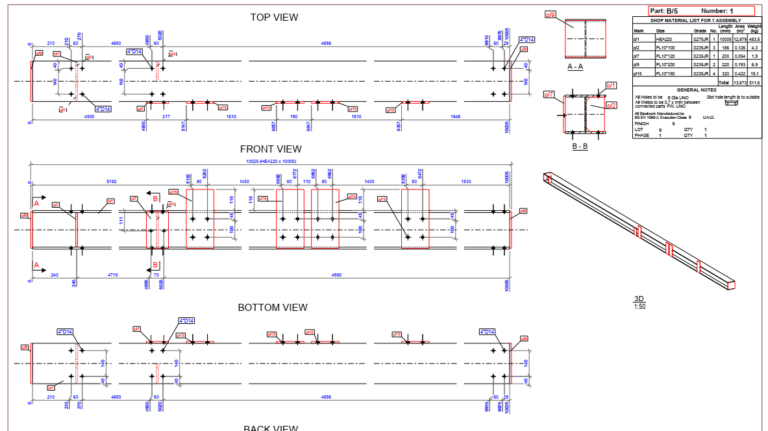
At Tekmetsan, our engineers and draftsmen work on the approved blueprint to create the details of the all steel parts that form the steel structure. These drawings will be used while manufacturing the components. For every individual shop drawing that is created, the below-mentioned aspects get the undivided attention:

• Material specification
• Manufacturing standards
• Required dimensions
• Surface setups
• Size
• Colour and paint requirements
• Welding
• Bolting

2. Cutting, Bending, Drilling

Cutting is the first part of structural steel fabrication. High-grade steel needs to be cut by cropping or sawing using different tools like sawing and drilling lines, laser cutters, plasma cutters, or water jets etc. 

The methods typically employed are sawing (cold sawing or band sawing), burning and shearing. All these tasks are performed under a closed manufacturing factory and all required safety measures are taken for these processes.

3. Welding & Assembly

Steel sections are assembled here to make complete structures. After cutting and forming of steel components are done, then the welding process begins to assemble it into a complete structure. Structural welding has its own set of codes, blueprints, and types of weld joints.

The process of welding involves the joining of two separate metal parts. The parts used in a welding application could be sheets, sections, bars or shapes. Welding is achievable through numerous methods and tool types. Often, a weld is achieved through the application of heat along the points where the two pieces are meant to be joined.

All the metal surfaces are cleaned by sandblasting or shot blasting before the paint application. Upon the request of the clients, Tekmetsan also offers hot dip galvanization coating to its clientele, however hot dip galvanization works are outsourced to specialized galvanization subcontractors.

Based on the paint selection of the customer, all painting works are performed in climate controlled environment according to the international standards.
Tekmetsan offers various types of paint coating for different levels of environments.

5. Packaging and Shipment

All the products are marked, packed and palletized and stored in the finish product warehouse. Tekmetsan uses overhead cranes and mobile high-up for the loading. We are able to load all means of transportation vehicles.